Download the aggregate data and calculation code. This companion contains the detailed method and sources behind the separate article.
This companion lets you follow each published number back to its inputs. It contains the counting rules, calculation choices, country table and source references. The main article explains the findings for visitors and website owners; this document records what was actually observed, what was modelled and what remains unestablished.
I What was counted
The supplied scanner archive contains records for 10,000 unique domains. Recovered timestamps place collection in October 2026. Review covered 703 cards: 578 selected candidates and 125 diagnostic controls. The candidates supply the wording analysis; the controls were used to look for findings missed by the earlier screening. This selection process does not establish AI-chat prevalence among the 10,000 domains. [D1] [Q1]
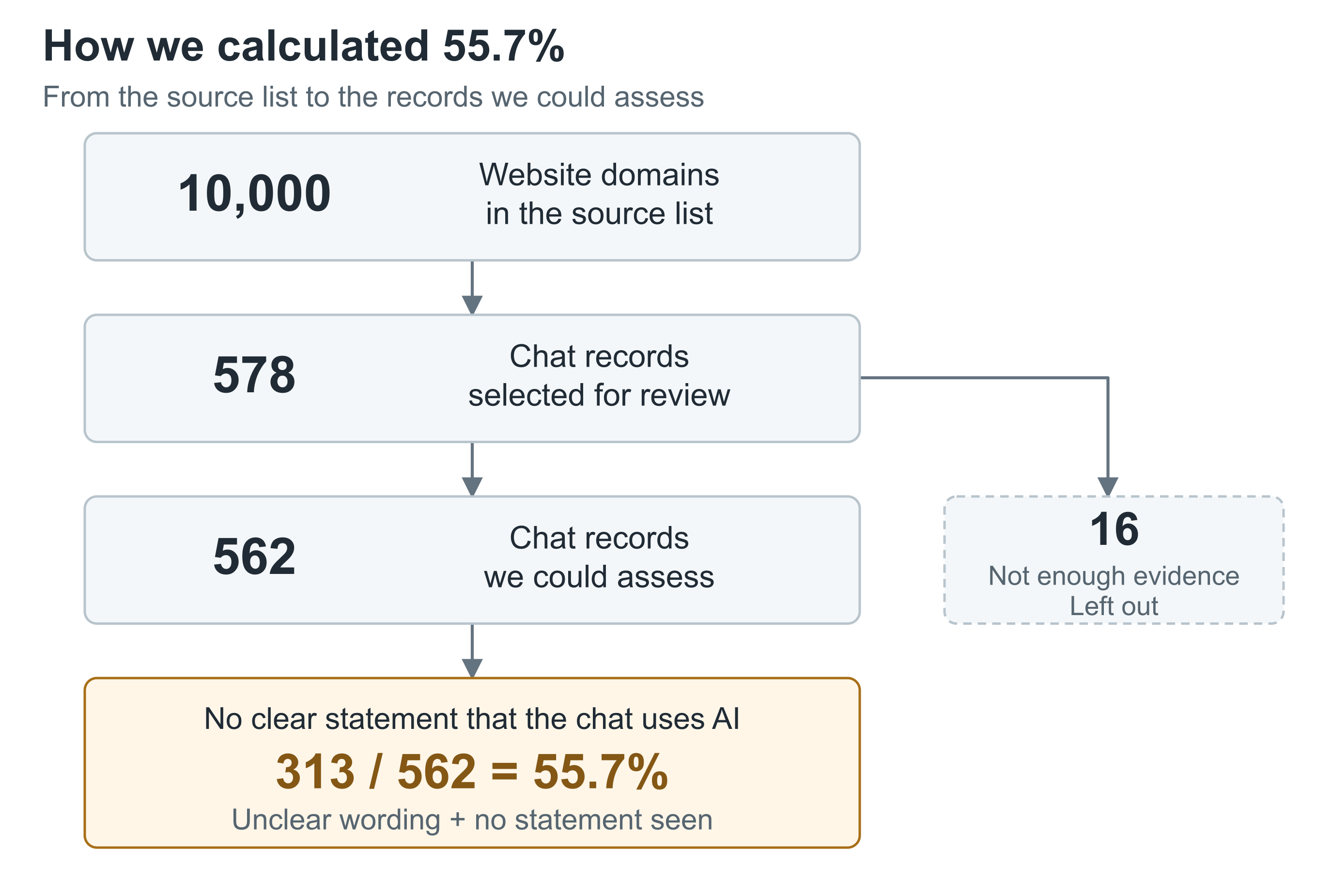
The collection is described as October 2026. Recovered timestamps fall on 14–15 October 2026; timestamps are missing for 654 of the 10,000 scanner records and 13 of the 703 archive cards.
Recovered scanner timestamps run from 2026-10-14 13:50 UTC to 2026-10-15 23:44 UTC. Archive-card timestamps run from 2026-10-14 13:50 UTC to 2026-10-15 23:43 UTC. These are recorded minute-level UTC values, not an independent clock audit. [D1]
A candidate is an interface selected for inspection after automated screening, without independent confirmation that the responding system uses AI. A company can operate several domains, and different sites can share a chatbot supplier. The calculation has not established which domains belong to the same company; its unit remains the archived candidate interface. [D1]
The archive is a non-probability collection: selection probabilities are not known for the population of EU companies or support chats. Scanner visibility, site access and the routes used to find candidates can influence which interfaces appear. More screenshots can strengthen a particular case without making the selected group representative.
Classification and corrected counts
The coding asks what can be read in the retained evidence. A clear statement explicitly identifies the interaction as involving AI. An ambiguous designation mentions an assistant or AI-related material without clearly identifying the chat itself. This includes a generic AI-notice link when its explanatory contents were not captured. A link can itself contain an explicit statement; links are not automatically classified as ambiguous. [Q1]
“No notice observed” means that an AI identity notice was not seen in the available chat material. It does not establish that no notice existed elsewhere or at another point in the interaction. “Insufficient evidence” means the record could not support a usable wording classification. That fourth category is excluded from the primary readable-case denominator and examined separately through bounds. [D1] [Q1]
Category | Count | Share of 562 |
|---|---|---|
Clear AI statement | 249 | 44.3% |
Ambiguous wording | 162 | 28.8% |
No AI notice observed | 151 | 26.9% |
Without clear statement in total | 313 | 55.7% |
Insufficient evidence, excluded | 16 | — |
The total row combines ambiguous wording and no observed notice; it is not an additional category. 578 selected cards minus 16 unclassifiable records gives the denominator 562. The 125 diagnostic controls are separate. The three readable categories sum to 562. [D1]
A targeted consistency review screened 48 generic-link candidates and examined 15 discordant cases visually. Thirteen moved from clear to ambiguous; two moved from no notice observed to ambiguous. The corrected counts were frozen on 15 November 2026. This was an AI-assisted review of a specific coding issue, not a complete independent human reclassification. [Q1]
Before correction, the 578 candidate categories were 262 clear, 147 ambiguous, 153 with no notice observed and 16 insufficient. Thirteen clear cases and two no-notice cases moved to ambiguous. The source files were preserved; 578 raw candidate JSON hashes were checked. The review screened 48 generic-link cases and visually revisited the 15 discordant ones. [D1] [Q1]
In one archived example, a footer displayed “KI-Hinweis” — an AI-notice link — next to a privacy link. Its explanatory contents were absent from the retained screenshots. We classified the designation as ambiguous because the visible text did not explicitly identify the chat as AI. This classification concerns the retained evidence, not the company’s intentions or liability. [Q1]
Counting only cases where no AI identity notice was observed gives 151 of 562, or 26.9%. The headline archival figure, 55.7%, also includes ambiguous designations. Calling both figures “undisclosed AI” would erase that distinction and assume the technology had been confirmed. [D1]
Sixteen candidate records could not be classified sufficiently. If all 16 ultimately contained clear statements, the without-clear share across all 578 candidates would be 54.2%. If none contained a clear statement, it would be 56.9%. These are bounds for those missing archival classifications alone. They say nothing about unselected sites, technology errors or the legal status of the observed cases. [M1]
The 125 controls uncovered one explicit AI statement missed by the earlier screening, but an AI respondent was not established in that case. This is evidence that the screening can miss relevant wording, not an estimate of its sensitivity or accuracy across the market. A separate 20-case blind check used another instance of the same model. Agreement in that exercise is a consistency check, not independent human validation; shared errors could survive both readings. [Q1]
II How the European scenario was calculated
The archive has usable candidate records under ten country tags. A European projection changes their relative contributions and makes assumptions about the 17 countries without comparable archival outcomes.
Our reference scenario retains each observed country's share of interfaces without a clear AI statement. For the other 17 countries, it assigns the pooled archival share, 55.7%. It then weights every country by its share of enterprises in the selected Eurostat Structural Business Statistics aggregate for 2024. Those enterprise counts total 33,978,235. They describe the covered business economy, not the population of companies operating AI chats. [D1] [M1] [E1]
The calculation is a weighted average: multiply each country's wording rate by its enterprise share, then add the 27 contributions. It produces 58.3%. This is a conditional European scenario for the archival wording indicator, not a measured EU legal violation rate. The 17 imputed countries contribute 24.5% of the total weight. [M1]
Country tags do not establish where a company is registered. Enterprise shares need not match the distribution of AI-chat operators. The selected interfaces may also differ from interfaces that the scanner missed. Weighting changes country composition; it does not establish that these other differences have been removed.
The main archive percentage is calculated directly: ambiguous plus no-notice-observed cases, divided by readable candidates. A stricter alternative counts only the no-notice-observed category. Missing records are not coded as compliant, non-compliant or free of AI. A failed capture, blocked page or unavailable chat can have several explanations; the archive does not establish which explanation applies to every missing case.
For the European model, each of the ten observed country rates receives an independent Jeffreys Beta(0.5, 0.5) prior, a statistical starting distribution. Its two parameters are updated with that country's without-clear and clear counts. The calculation draws 20,000 sets of country rates using a fixed random seed. In each draw, the 17 imputed countries receive the same pooled rate derived from that draw's observed countries. This preserves their dependence on the same evidence. The reported interval uses the 2.5th and 97.5th percentiles of the resulting weighted averages. [M1]
Reproduction parameters: 20,000 draws; random seed 20261111038; independent Jeffreys Beta(0.5, 0.5) priors for the ten observed country-tag proportions. Within each draw the seventeen unobserved countries share one pooled draw computed from the observed-country draws; they are not assigned seventeen independent extra observations. The 2.5th and 97.5th percentiles form the conditional 95% interval. [M1]
The model's 95% Bayesian credible interval is 53.9–62.4%. It describes uncertainty in country rates within the specified model. It does not cover selection bias, coding mistakes, shared vendors or company ownership, or errors in transferring the pattern to unobserved countries. The interval is therefore not a guarantee that a European market rate lies within those limits. [M1]
If interfaces without clear wording were twice as likely to enter the archive as interfaces with clear wording, the projection would be 41.8%. If they were half as likely, it would be 73.2%, with other reference assumptions fixed. These are chosen sensitivity scenarios, not measured selection probabilities or confidence limits. [M1]
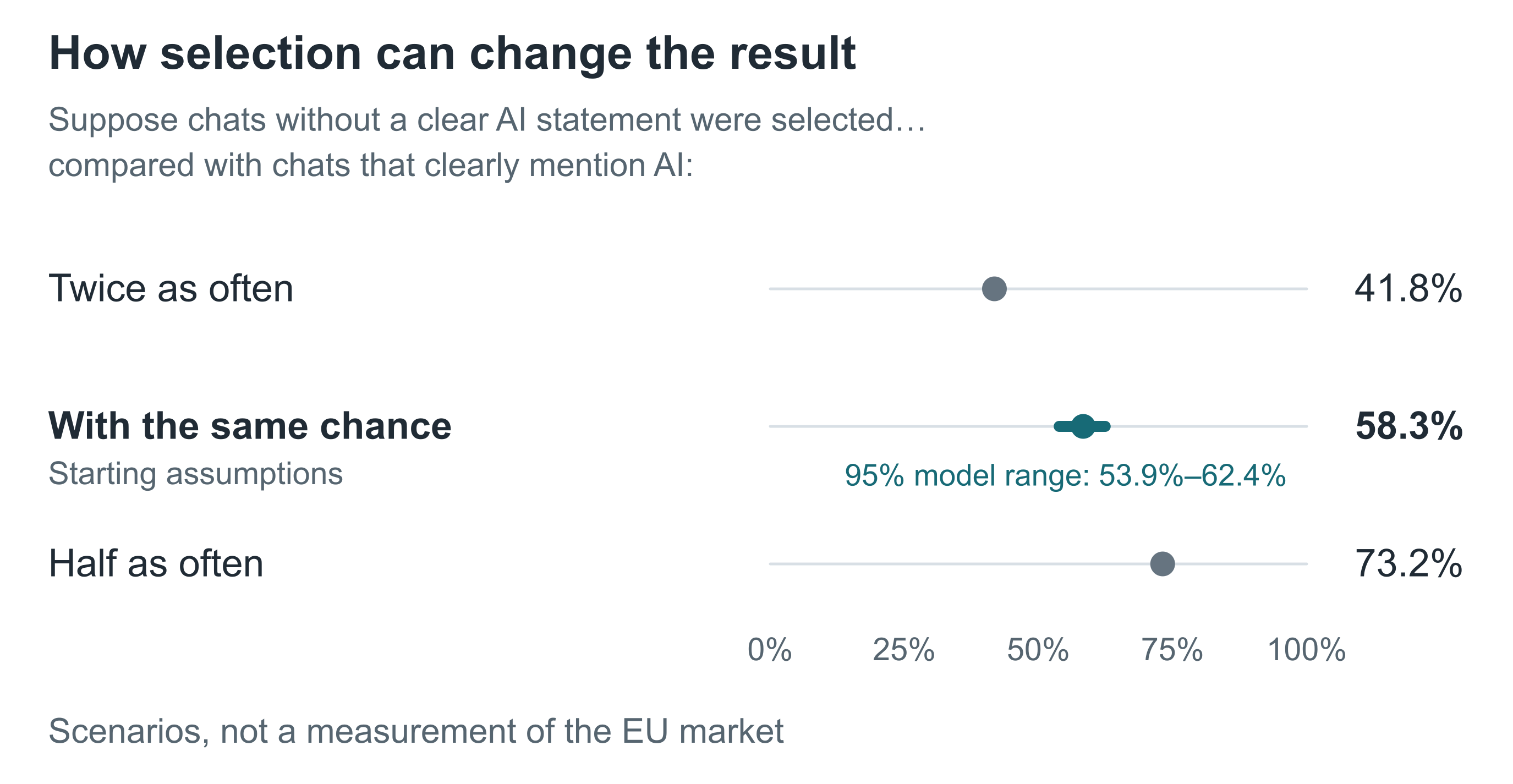
The American Association for Public Opinion Research (AAPOR) calls for researchers reporting precision in non-probability surveys to describe the model and validate its assumptions. Here, the assumptions needed to extend the archive to the EU market remain unvalidated. The reported interval concerns model parameters, not market accuracy. [S1]
Calculation checkpoints
Calculation | Percent |
|---|---|
Archive percentage | 55.6939501779 |
EU27 reference scenario | 58.3353202898 |
Conditional 95% lower | 53.8625442258 |
Conditional 95% upper | 62.4396468554 |
Strict no-notice archive | 26.8683274021 |
Strict no-notice EU scenario | 30.3403438222 |
16 missing all clear, archive | 54.1522491349 |
16 missing all without clear, archive | 56.9204152249 |
16 missing all clear, EU model | 57.1701263622 |
16 missing all without clear, EU model | 59.3722387330 |
Selection ratio k=2 | 41.7931776745 |
Selection ratio k=0.5 | 73.1508225571 |
Unobserved countries minus 20 pp | 53.4320726668 |
Unobserved countries plus 20 pp | 63.2385679129 |
Unobserved countries arbitrary minimum | 44.6812588484 |
Unobserved countries arbitrary maximum | 69.1974969637 |
Unobserved country half chat uptake | 58.7043371032 |
Unobserved country double chat uptake | 57.8152559224 |
Checkpoint values are shown to ten decimal places for reproducibility, not as a claim of that degree of market accuracy. The selected 45-scenario grid spans 13.9050287891–92.5310319722%. Its endpoints are consequences of chosen assumptions, not confidence limits. [M1]
Observed country cells contribute 75.4837618846% of auxiliary enterprise weight; imputed cells contribute 24.5162381154%. Neither a market effective sample size nor ±3 percentage-point market precision has been established. The legal numerator, legal denominator and legal violation percentage remain null in the data. With no identifying assumptions, the legal percentage is unconstrained between 0% and 100%; this is not a useful confidence interval or a measured result. [M1]
III Country inputs for all 27 EU members
Archive country tags contribute observed wording counts for ten countries. For seventeen countries with no classified archival outcomes, the scenario assigns the pooled archival proportion of 55.7%. Assigned values are assumptions, not measured national rates. Country tags do not establish the registered location of a company. All percentages concern interface wording, not established legal violations.
Country tag | Readable n | Without clear n | Input rate | Rate basis | Weight |
|---|---|---|---|---|---|
Austria | 0 | — | 55.7% | Pooled value | 1.85% |
Belgium | 47 | 30 | 63.8% | Archive | 2.74% |
Bulgaria | 0 | — | 55.7% | Pooled value | 1.22% |
Croatia | 0 | — | 55.7% | Pooled value | 0.74% |
Cyprus | 0 | — | 55.7% | Pooled value | 0.28% |
Czechia | 46 | 13 | 28.3% | Archive | 4.02% |
Denmark | 56 | 32 | 57.1% | Archive | 1.12% |
Estonia | 0 | — | 55.7% | Pooled value | 0.46% |
Finland | 0 | — | 55.7% | Pooled value | 1.41% |
France | 57 | 39 | 68.4% | Archive | 16.03% |
Germany | 98 | 40 | 40.8% | Archive | 9.52% |
Greece | 0 | — | 55.7% | Pooled value | 2.84% |
Hungary | 0 | — | 55.7% | Pooled value | 2.66% |
Ireland | 0 | — | 55.7% | Pooled value | 1.21% |
Italy | 49 | 30 | 61.2% | Archive | 13.69% |
Latvia | 0 | — | 55.7% | Pooled value | 0.45% |
Lithuania | 0 | — | 55.7% | Pooled value | 1.09% |
Luxembourg | 0 | — | 55.7% | Pooled value | 0.14% |
Malta | 0 | — | 55.7% | Pooled value | 0.18% |
Netherlands | 60 | 38 | 63.3% | Archive | 7.13% |
Poland | 33 | 21 | 63.6% | Archive | 8.30% |
Portugal | 0 | — | 55.7% | Pooled value | 4.33% |
Romania | 0 | — | 55.7% | Pooled value | 3.03% |
Slovakia | 0 | — | 55.7% | Pooled value | 2.01% |
Slovenia | 0 | — | 55.7% | Pooled value | 0.61% |
Spain | 69 | 45 | 65.2% | Archive | 10.35% |
Sweden | 47 | 25 | 53.2% | Archive | 2.57% |
Zero readable cards means no classified archival observations for this input. A dash in the numerator means that no observed numerator exists; it does not mean zero failures.
Auxiliary weights use the share of enterprises in Eurostat 2024 SBS, not the share of companies with AI chats. Rounding may prevent displayed weights from summing to 100%.
The new Finnish and Estonian technical records do not change the zero classified archival outcomes shown for FI and EE here.
IV New collection and unresolved outcomes
Later collection has added records without adding classified outcomes to this calculation. The latest supplement contains records for 346 Finnish company IDs and 345 result files from an Estonian sample of 350 companies. Their outcome tables do not establish AI use, notification duty or non-compliance; some records contain only partial technical observations. They therefore cannot be added as positive or negative outcomes. [N1]
Collection | Target | Results | Missing result | Classified outcomes |
|---|---|---|---|---|
FI S60 | 500 | 346 | 154 | 0 |
EE S60 | 350 | 345 | 5 | 0 |
Finnish terminal records comprise 340 needing technical review, four failures and two access restrictions. The 346 include 81 earlier records plus 265 later ones; adding these components again would double count. Estonian results include 235 partial records and 110 requiring website discovery. All these collection counts remain outside the 562 disclosure denominator; they are not coded as either compliant or non-compliant. [N1]
V Legal criteria and sources
The first legal question is whether the system falls within the AI Act’s definition of AI. That definition covers systems that operate with some autonomy and infer from their inputs how to produce outputs. It is broader than generative AI; a chat window or automated menu alone does not establish that the definition is met. AI Act, Article 3(1).
For AI systems intended to interact directly with people, Article 50(1) places the disclosure duty on the provider. Article 50(5) requires the information to be clear, distinguishable and accessible no later than the first interaction or exposure. A notice beside the conversation may meet that timing; the law does not prescribe a mandatory opening-message script. Article 50(1) and (5).
The Commission’s non-binding guidelines, published in the Official Journal as C/2026/6005 on 12 November 2026, explain the practical requirements. A generic reference to an assistant may leave its AI nature unclear; information confined to terms, documentation or a URL cannot by itself replace an effective notice during the interaction. Wording, position and visibility all matter. Commission transparency guidelines, points 33–38; official Spanish text reproduced by BOE.
The website owner and the provider
A provider develops a system, or has it developed, and supplies it or puts it into service under its own name or trademark. A deployer uses a system under its authority. For example, a retailer using a vendor’s ready-made chatbot may be a deployer; a retailer commissioning its own system may also be its provider. Article 3(3) and (4).
Installing an unchanged third-party chatbot does not, by itself, transfer the provider’s Article 50(1) duty to the website owner. Changing the bot’s displayed name is not a complete legal test either: responsibility depends on the development and supply arrangements described above. Commission guidelines, OJ C/2026/6005, points 10–11.
When the duty applies
The notification duty has a contextual exception where the AI nature of the interaction is already obvious to a reasonably informed, observant and careful person. A researcher’s ability to recognise automation does not establish what the intended audience would understand. Article 50(1) also contains a specific, limited law-enforcement exception. Article 50(1).
Territorial scope requires its own evidence. The Act covers relevant providers supplying systems in the Union, deployers established or located there, and certain actors outside the EU whose system outputs are used in the Union. A European domain ending or the language of a website cannot settle those facts. Article 2.
The direct-interaction duty applies from 2 August 2026. The transition to 2 December 2026 concerns Article 50(2) marking for specified generating systems placed on the market before 2 August 2026; it does not postpone Article 50(1). Articles 111(4) and 113.
These conditions must be checked before an archived wording observation can become a finding of legal non-compliance.
Complaint routes and penalties
If something appears wrong, preserve the context: the website address, date, opening screen, notices shown before the conversation and the relevant exchange. Note which actions you took and what remained inaccessible. Germany’s complaint guidance illustrates the information an authority may need. Bundesnetzagentur complaint guidance.
Article 85 allows a person or organisation with grounds to consider that the Act has been infringed to complain to the relevant market surveillance authority—the public body responsible for supervising compliance. The Commission’s national authority directory helps locate that body. Germany provides an official complaint form. We checked that route, but did not submit a complaint or test every national procedure. Article 85.
Begin with the system you actually operate. Establish whether it uses AI, whether it directly interacts with visitors, which entity is its provider, and which configuration delivers the notice. Ask the supplier to identify these responsibilities and retain the answer. Commissioning a system under your own name can require a different assessment from installing a standard third-party widget. Articles 3 and 50.
Then test the visitor’s experience from the opening screen. Check the notice in the languages and device layouts you serve, including any change from a human to AI during the conversation. As an illustrative wording choice, “You are chatting with an AI assistant” identifies the system more directly than “virtual assistant”. That example is not a statutory template: timing, accessibility and the surrounding context still matter. Commission guidelines, OJ C/2026/6005, points 33–38.
Article 99(4)(g) places Article 50 infringements under a maximum of €15 million or, for an undertaking, 3% of worldwide annual turnover in the preceding financial year, whichever is higher. SMEs—micro, small and medium-sized enterprises, including start-ups—benefit from the lower ceiling under paragraph 6. Paragraph 6a also applies the lower ceiling to small mid-cap enterprises, a separate EU size category, for these infringements. Whether a fine is imposed, and its amount, depends on the circumstances. Article 99(4), (6), (6a) and (7).
VI Validation and disclosure of interests
A defensible company-level legal estimate needs a chain of evidence. The sample must cover a defined target population, with a justified selection and weighting method. Domains must be linked to companies without counting the same company repeatedly. The technology and direct interaction must be established. The responsible role, applicable duty, timing, accessibility and relevant exceptions must then be assessed. A clear screenshot can help with that assessment, but cannot supply every link.
Independent human review should test classifications against the original evidence, record disagreements and resolve them under a stated rule. It should include apparently clear cases, ambiguous cases and missing outcomes. A larger sample drawn through the same selective route would not, by itself, resolve uncertainty about market coverage. Later country collections may help once their sampling frames, completed outcomes and comparability have been evaluated. [Q1] [N1]
This research is connected to Article50 Guard, a service intended to help identify and assess website chat transparency. Its publisher therefore has an interest in demand for such checks. AI tools assisted evidence organisation, coding review, calculation and drafting. Neither that assistance nor agreement between model sessions should be presented as independent legal certification.
The release supplies aggregate inputs, category definitions, a correction summary and reproducible calculations. The underlying site-level evidence is retained privately; the public version does not contain a company-by-company table. Readers can reproduce the aggregate arithmetic, but a full re-evaluation of individual classifications requires access to the original evidence.
VII Reproduce the calculations
Archive numerator. 162 ambiguous designations plus 151 interfaces where no AI identity notice was observed in the retained evidence.
Archive denominator. 578 scanner-selected candidate cards minus 16 with insufficient evidence. The 125 diagnostic controls are outside this denominator. Cards are not independently verified unique companies or confirmed AI chats.
Conditional EU27 value. An enterprise-weighted scenario based on ten archive-tag proportions and the pooled proportion assigned to seventeen countries. It is not a measured EU market prevalence or a legal-violation estimate.
Coding and aggregate inputs were frozen on 15 November 2026 after 15 targeted corrections. Source files were not changed. The 95% conditional parameter interval excludes selection, measurement and transport bias; imputation adds no observations or effective sample size.
The accompanying data package contains the aggregate inputs and the Python calculation. From its root directory, run “python reproduce.py --output recalculated” with Python 3. This recreates the headline values, the country table and the sensitivity scenarios without changing the supplied files. The fixed simulation seed is 20261111038.
Frozen calculation version: release-calculation-2026-11-15-v1. SHA-256 of data/aggregate-inputs.json: fc167533b47226a196a4398ff98cd5703b3b3061fb3b4babc0ed9328da45ab17. Public files contain aggregates; reproducing the arithmetic does not independently validate the underlying classifications. [D1] [M1]
Sources and data index
D1 — Frozen archive totals and corrected aggregate inputs. The underlying interface cards and scanner rows remain private; source hashes preserve their connection to the aggregates. Files: data/aggregate-inputs.json; data/results.json.
Q1 — The targeted review changed 15 candidate categories: 13 clear-to-ambiguous and 2 no-notice-to-ambiguous. Private decisions preserve evidence-image hashes. This is not a complete independent human validation or an estimated classification accuracy. The quality summary also records the 125 diagnostic controls and the 20-case agreement check using another instance of the same model. Files: data/coding-change-summary.json.
M1 — Reproducible conditional EU27 projection, parameter uncertainty and chosen sensitivity scenarios. The model assigns the pooled archival proportion to 17 countries without classified archive outcomes; it creates no new observations. Files: reproduce.py; data/results.json; data/EU27-modelled-country-projections.csv; data/sensitivity-scenarios.csv.
N1 — Technical collection progress in the latest supplement: 346 Finnish terminal records; 345 Estonian result files from 350 selected companies. None supplies a completed AI/duty/disclosure outcome to add to the archive denominator. Files: data/collection-progress.csv.
E1 — Eurostat Structural Business Statistics: 2024 enterprise counts, ENT_NR, B-S_X_O_S94. These supply auxiliary country weights, not counts of AI-chat companies. All 27 country values and the EU total matched the frozen source on 15 November 2026. Files: data/eurostat-source-check.json; data/aggregate-inputs.json. Eurostat API.
S1 — AAPOR Disclosure Standards. Disclosure of sampling methods and the assumptions behind precision measures. This reference does not validate this study’s transport assumptions.
The legal sections link directly to the relevant AI Act articles, the Commission’s non-binding transparency guidelines and national guidance. Dated access notes are in data/source-ledger.json and data/full-manuscript-source-notes.json; the source update below supersedes their earlier guidance-version and Omnibus-access notes. Product-page checks are in data/product-link-check.json. Access was checked on 15 November 2026; no official complaint, private report or live scanner request was submitted for this publication check.
Legal-source update, 15 November 2026. The current reference is Commission guidelines, OJ C/2026/6005, 12 November 2026; the relevant points were read in BOE’s official Spanish reproduction. The earlier English C(2026) 5054 final of 20 July approved the draft’s content and remains a historical source. The current English download could not be opened in this check. The official PDF of Regulation (EU) 2026/1744 was successfully opened and its relevant amendments checked, superseding earlier reports that the standalone Omnibus text was inaccessible. These source updates do not change the study’s method or numbers.