I Who is answering
The shop and conversation in the introduction are fictional.
Imagine: your new laptop has arrived. You unpack it, press the power button and wait. Nothing. You plug in the charger and try again. Still nothing. You open the shop’s support chat on your phone.
You: “My new laptop won’t turn on. What should I do?”
Support: “Open the laptop’s settings and run our online diagnostics.”
You: “I can’t. It won’t turn on.”
The reply is polite, confident and useless. You ask to speak to a person. The chat sends you back to the same instructions. Now you have another problem: you cannot tell whether anyone has heard you at all.
There is a name above the messages, with a flashing “typing” indicator beside it. Neither tells you whether you are talking to a person or to artificial intelligence (AI).
The strange reply does not solve the mystery either. A person might misunderstand you, while a program might be following a set script. But a customer should not need to understand the software to know who they are talking to.
At Article50 Guard, our chat-checking service, we asked: how often do companies with AI chatbots in the European Union (EU) fail to disclose their use of AI when the law requires it? We began with a practical check: what does a person actually see when they open the chat?
II Two real decisions that explain why the rules matter
These two real cases concern misleading answers and personal data. Neither is a decision under Article 50, and neither is part of our sample.
Air Canada — a wrong answer with a real cost. A passenger asked the airline’s chatbot about a discounted fare for travel following the death of a loved one. The bot wrongly said that the discount could be claimed after the flight. The passenger relied on the answer, but his request was refused. On 14 February 2024, the British Columbia Civil Resolution Tribunal held Air Canada liable for negligent misrepresentation and ordered the airline to pay the passenger, Jake Moffatt, C$812.02, including interest and fees. Moffatt v Air Canada, 2024 BCCRT 149, paragraphs 13–32 and 44. Air Canada argued that the correct terms were on another page of its website. The tribunal rejected that argument: the passenger should not have to guess whether to trust the chat or the page setting out the rules.
Replika — an AI label does not explain how your data is used. Replika offers a virtual companion you can talk to as a friend, adviser or romantic partner. This format encourages personal conversations. But knowing that you are talking to a program does not mean you understand how the company uses what you tell it.
Garante — the Italian public authority that oversees compliance with personal data protection rules — investigated Replika. The service is operated by Luka Inc., the US company that developed and runs the chatbot. The regulator found that, as of 2 February 2023, Luka had not established lawful grounds for processing data through the service. In other words, the company had not shown which legal basis allowed it to use personal information. Its privacy policy also failed to explain clearly why the data was processed and how long it was kept. Decision of 10 April 2025.
A separate issue concerned children. The service stated that it was not intended for minors, but on the date examined it did not check users’ ages either at registration or during use. The authority also found shortcomings in the mechanism added later.
The regulator fined Luka €5 million and required it to remedy the infringements. The company is challenging the decision; we have no confirmed outcome of any subsequent court proceedings. This fine was imposed under the GDPR1 — the European regulation on personal data protection. It was not a fine for failing to display an AI label. Garante’s announcement and appeal notice.
III When a chat must disclose AI use
For the customer with a laptop that will not work, the first question is simple: is a person reading their message, or is a program generating the answer? Article 50 of the AI Act — the European Union’s regulation on artificial intelligence — gives this question legal significance. As a general rule, the provider of an AI system intended to interact directly with people must design it so that people are told they are interacting with AI. Article 50(1).
What the visitor must see
The notice must be clear, distinguishable and accessible. It must be shown no later than the first interaction. It does not have to appear in the bot’s first message. Let us return to the laptop customer: they open the chat and immediately see “You are chatting with an AI assistant” above the input field. Before sending a question, they know who will answer. A prominent, accessible label in that position serves the purpose of the notice.
Another option is an equally clear greeting when the chat opens. But if the customer has already described the fault and received advice before seeing the admission “I am AI”, the notice is too late. The law specifies what the notice must say and when it must appear, but does not require one fixed wording. Article 50(5).
“You are chatting with an AI assistant” is clear wording that meets the requirement to state explicitly that AI is being used. Display it in time, prominently and accessibly, as in the example above.
“Virtual assistant” is ambiguous wording. It does not tell you whether the assistant uses AI. If the duty to inform applies and this is the only explanation, the requirement of Article 50(1) has not been met. Visitors should not have to decipher the service’s name themselves. Mentioning AI only in the terms of use or behind a general link also does not replace a clear notice at the start of the interaction. This is explained in the European Commission’s guidance published on 12 November 2026, paragraphs 33–38.
There is an exception: when the interaction with AI is already obvious to a reasonable and attentive person in the circumstances. This means an ordinary, informed visitor, not an AI specialist. But we do not recommend building a public-facing chat in the hope of relying on this exception. People are in a hurry, miss explanations and use a service in ways the company did not expect. A customer with a laptop that will not work wants to solve the problem, not guess what technology is behind the support window. Our recommendation is therefore simple: state explicitly that AI is being used, even if the developer thinks it is obvious. Article 50(1).
The McDonald’s hot coffee case2 offers a lesson: “it is obvious anyway” is an unreliable basis for communicating with customers. Even a familiar product can lead to a dispute about its dangers and the company’s responsibility. The practical lesson for a chat owner is the same: it is better to explain who is answering in advance than to argue later about what the visitor should have worked out for themselves.
Who must ensure this happens
The law uses the term provider. Broadly, this is a person or organisation that develops an AI system, or commissions its development, and places it on the market or puts it into service under its own name. A company using the system may have a different role: deployer — an organisation using AI. The role depends on how the service is developed and supplied, not simply on the logo on the website. Article 3(3) and (4).
Imagine a shop that installs another company’s chatbot without modifying it. Installing someone else’s bot does not in itself protect the shop from customer claims. A dispute about incorrect promises, refunds or data use may also concern the shop’s own actions. Who becomes a party to the proceedings depends on the claims and the circumstances of the case. It therefore makes sense for the shop to check the notice itself and work with the provider to get it corrected. A business that commissions the development of a system and launches it under its own name becomes a provider itself. Simply renaming the chat persona does not settle the question. Nor is making a technical change the only way to become a provider. European Commission guidance, paragraphs 10–11.
A website owner needs clear answers to two questions: whether their chat breaches the requirement to disclose AI use, and who is responsible for the notice. This means establishing who provides the system, who uses it and who can correct what the visitor sees. Article 3(3) and (4).
This is where Article50 Guard can help. We offer a preliminary chat check and help with a clear AI notice. You can start with our scanner, then discuss what the results mean for your website: which signs need attention, what to clarify with the provider and what changes to make.
When the European rule applies
The duty to disclose AI use in direct interactions has applied since 2 August 2026. It may also affect providers outside Europe, particularly when a system is placed on the EU market. Other connections may matter too, such as the use of the system’s outputs in the EU — meaning the answers, recommendations or other content it creates. Imagine a company outside the EU using its AI chat to answer customers in France about returning a product. The answer is generated abroad but used in the EU. The server’s location alone does not place this activity outside European rules. A website’s domain extension or language is not enough to determine the answer. Article 2; Article 113.
Two separate duties are easily confused here. The message “You are chatting with AI” is intended for a person. Article 50(2) concerns a different task: the provider must ensure that AI-generated text, images, audio and video carry markings that technical tools can read to identify their artificial origin. For systems placed on the market before 2 August 2026, the deadline for meeting this second duty has been extended to 2 December 2026.
Suppose the fictional company “Mayak AI” placed its chatbot on the EU market in June 2026. The bot writes its own replies to customers. From 2 August, visitors must already be clearly informed that they are interacting with AI. By 2 December, the provider must complete a different task: add technical markings to the generated replies so that software can recognise that the text was created by AI. The extra time is for this marking. The company cannot wait until December to tell people they are interacting with AI. Article 50(1) and (2); Article 111(4).
Who processes what you write
Knowing that AI is answering you does not tell you what happens to your name, order number or other personal information. If the GDPR1 applies and the data is collected from you, the service must usually explain at the time of collection who is responsible for processing it, why and on what legal basis it uses the data, who it shares it with, and provide the other necessary information. Let us return to our fictional laptop customer. To arrange a return, the shop asks for their name, order number and address. Alongside the request for data, it needs to explain clearly who is collecting it and why: for example, to find the order and arrange the return. The customer must also be told what information the delivery service will receive, on what basis it will be used, how long it will be kept and how to exercise their rights. This explanation can be provided in an accessible privacy notice. An AI label does not replace it. European Commission explanation of GDPR Articles 12–14. We did not assess compliance with the GDPR1 in this study.
IV What we found
Under our assumptions, our model-based estimate for the European market is that 58.3% of chats have no clear AI disclosure. This is potential non-compliance with the requirement to disclose AI use where that obligation applies to the chat. The model extrapolates our observations to all 27 EU countries using the assumptions described in the methodology. Calculation and assumptions.
In our in-depth review of more than 500 chat records, the observed proportion was 55.7%. These materials contained no clear indication that the chat used AI. That is slightly more than half. Data
Two different situations lie behind this figure. In some cases, the wording left the question open. In others, we saw no AI disclosure at all. The chart shows these groups separately.
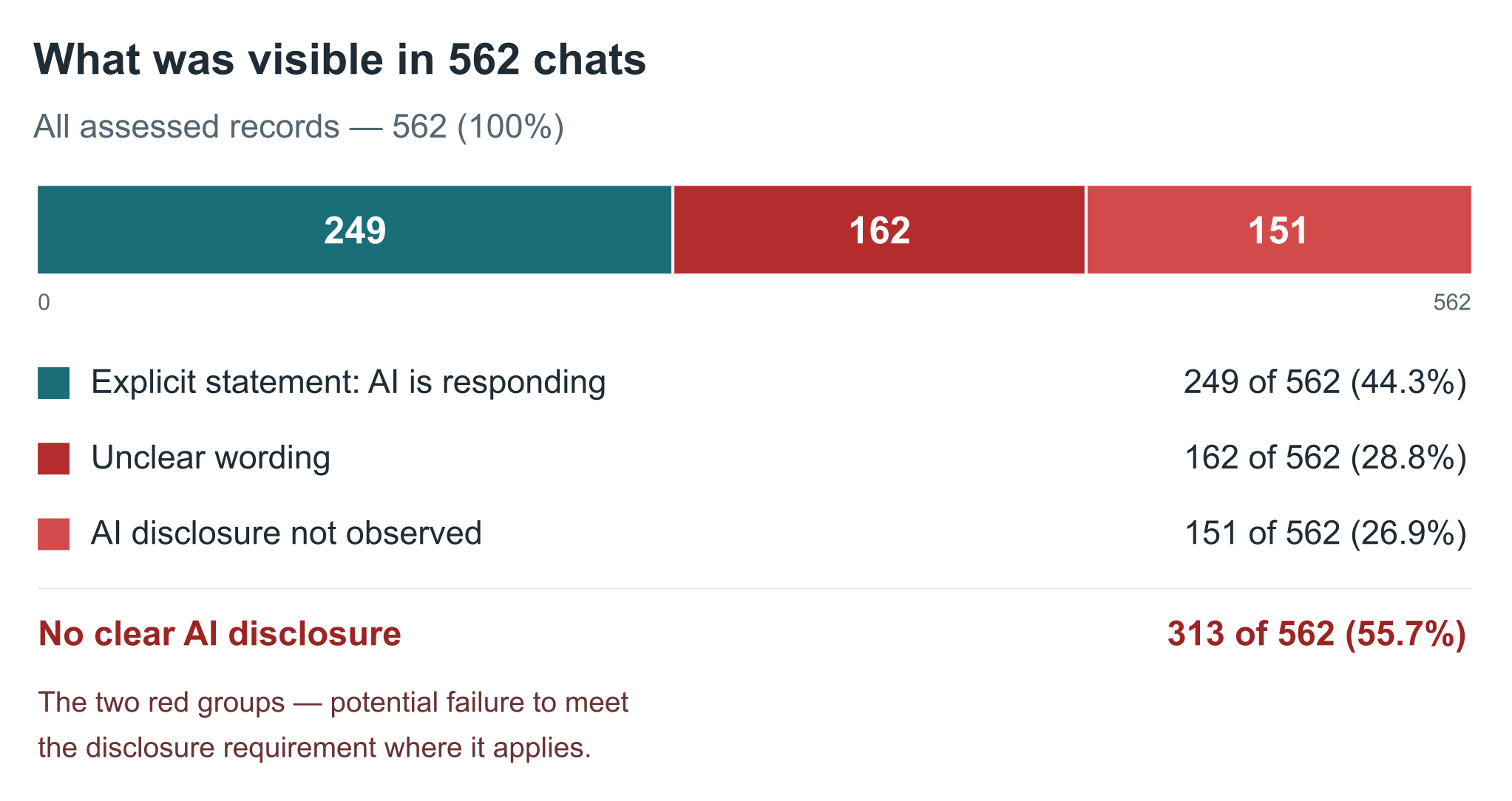
An unclear disclosure is a reason to look more closely. At Article50 Guard, we can assess your chat individually: explain what its disclosure means and what information is needed to assess compliance with the requirement. You can start with a preliminary check using our scanner.
For example, a screenshot without an AI label may show a chat in which a human is responding. Or the disclosure may have appeared on a previous screen that was not saved. To conclude that a violation has occurred, we need to know how the system works and what the visitor was told.
V Our estimate for the European market
58.3% is our model-based estimate of the proportion of chats without a clear AI disclosure in the European market. It is based on the records we checked. Calculation and assumptions
This estimate shows the possible scale of disclosure problems in the European market. Reaching a legal conclusion about an individual chat requires a separate assessment. Calculation and assumptions.
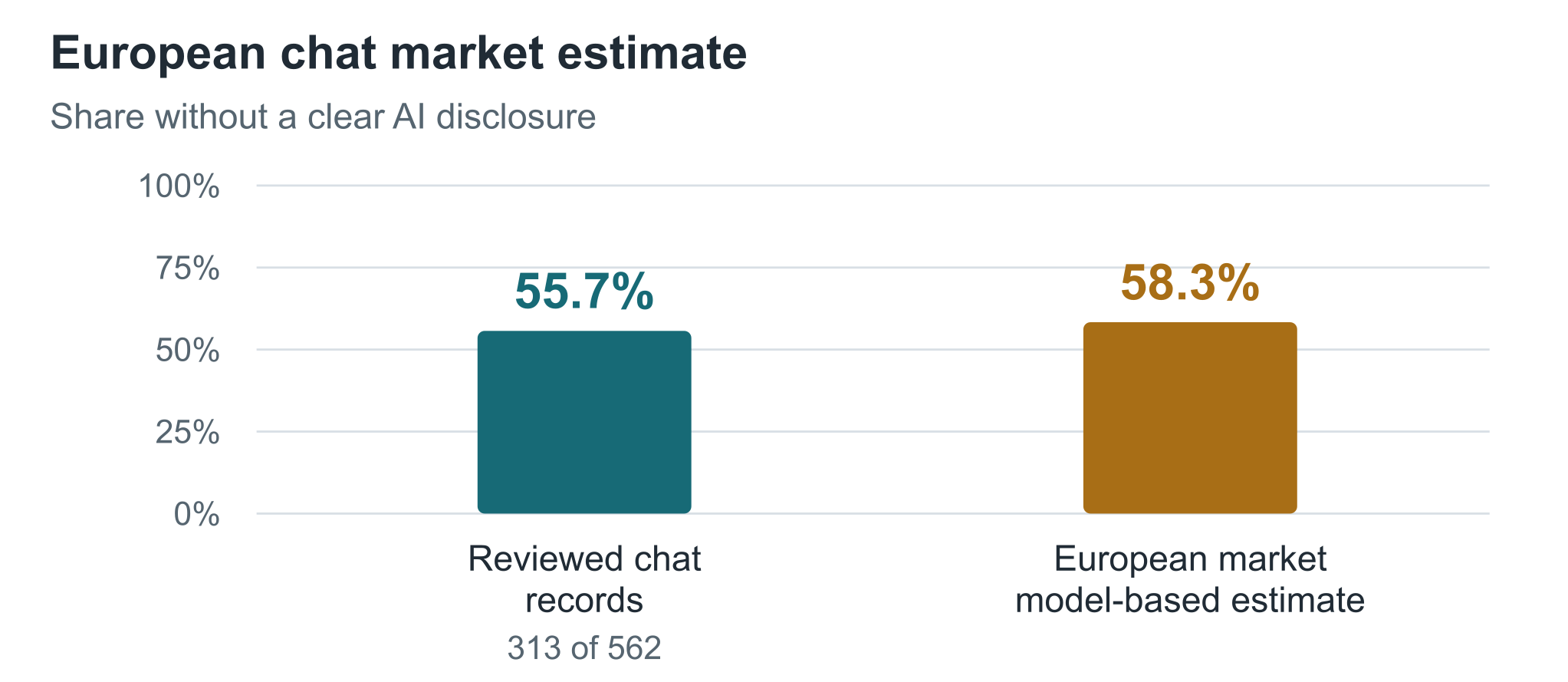
In the model, countries with more enterprises receive greater weight. For countries without comparable observations, we used the overall proportion from the records we checked. This is how we arrived at the European estimate; the full calculation and alternative approaches are available in the methodology. Calculation and assumptions
VI What visitors and website owners can do
If you are a visitor
You should not need a technical education to understand who is answering you. Start with the label in or next to the chat. You can ask whether you are talking to AI, but the answer is another claim that needs checking. A polished sentence, an odd mistake or a typing indicator proves nothing on its own.
If something looks wrong, save the website address, the date, the opening screen and the relevant messages. Record any label you saw and when it appeared. When reporting a problem, do not share passwords, your full card number or unnecessary personal information.
If you would like us to look at the situation,
send a private report to Article50 Guard. Describe the chat and provide the website address; you can leave out your email address. The form sends your report to our team, not to a regulator.
For an official complaint, Article 85 provides for contacting the competent market surveillance authority where there are grounds to suspect a violation. The European Commission’s directory of national authorities can help you find it. Germany, for example, has an official complaint form. Procedures vary by country. Article 85.
If you own a website or build chatbots
An individual legal assessment takes time and requires a lawyer’s involvement. It involves examining contracts, technical documentation and each party’s role: who builds the chat, who uses it and who controls its settings. This assessment takes the circumstances of the particular project into account.
You can start with a simple question: what does a visitor to your website see? A free preliminary automated check by Article 50 Guard will help you understand how AI use is disclosed and give you a PDF of the results. This gives you something concrete to use when discussing next steps with your team or a specialist.
Visit the Article 50 Guard website to start with a check. If you need help with clear wording and placement of the label, we will discuss your needs. We will agree the scope and price with you before any paid work begins.
What a fine means for your business
The general maximum fine for a breach of Article 50 is €15 million or 3% of the enterprise’s worldwide turnover for the preceding financial year, whichever is higher. For micro, small and medium-sized enterprises, the lower ceiling applies. The same rule applies here to the separate small mid-cap3 category — businesses of an intermediate size, as defined by law. Article 99(4)(g), (6) and (6a).
Correcting a problem after a complaint or notification does not, in itself, remove liability for a violation that has already occurred. When deciding on a penalty and its amount, the authority considers how long the violation lasted, cooperation with those investigating it and measures to reduce harm to people. Prompt resolution of the problem and documented action by the company are grounds for mitigating the consequences. Article 99(7).
You can start with a clear task: identify your role, examine the disclosure and address any gaps. Article50 Guard offers a preliminary check and the option to request help based on the results. We help you work through the practical steps; a private service cannot promise exemption from fines.
After a redesign or a change of chat provider, it is worth checking everything again.
Article50 Guard offers regular checks and help with disclosures to teams managing one or more websites. This allows the task to become part of routine website maintenance.
VII How we carried out the checks
We began with an automated check of 10,000 domains — website addresses — in October 2026.
We found more than 5,000 chats using bots and classified 2,915 cases as violations of the AI disclosure requirements. According to our information, the chats selected for in-depth analysis came from this larger dataset.
In the in-depth analysis presented here, we assessed saved screenshots of more than 500 support chats: did the wording clearly indicate the use of AI? The exact number is 562; this is the number used in the calculations and charts. The data and full methodology are available via the link. Data
We counted what was visible on these screens. We looked at the chat from the customer’s perspective: did the saved screenshot make it clear that AI was responding, and what words were used to explain this? Details of how the records were selected and checked are available in the methodology.
VIII An unclear label and no label
In one of the saved chats, the German wording “KI-Hinweis” — roughly “AI notice” — appeared next to a privacy link. We could not open the page it linked to. We could see a reference to AI, but the wording itself did not explain that AI was responding in this particular chat or how it processed your information. We therefore classified the wording as unclear. Review method
This example explains why we distinguish between two groups. The wording was unclear in 162 records. In another 151, we saw no AI label in the available materials. Together, these account for 313 cases, or 55.7%. Data
If we count only the second group — cases where no label was observed — the figure is 26.9%. This narrower figure excludes chats where a reference was present but did not make it clear that AI was responding. Choosing between these measures changes the question itself, so we report both. Data
A clear label does not prove compliance with every requirement either. It may have appeared too late or been difficult to access. Conversely, a disclosure missing from a saved screenshot may have been visible earlier. To assess an individual chat, we need to follow the visitor’s journey from the very beginning. Article 50(5).
IX What we were able to establish
The in-depth review found no clear indication of AI in 55.7% of the records assessed. Our conditional model-based estimate for the European market is 58.3%. These figures concern disclosure. Establishing the proportion of legal violations also requires confirmation of AI use, the responsible party and the applicable obligation, as well as a sample that supports conclusions about the whole market. Data Calculation and assumptions
For visitors, the next step is to understand who is responding and where to report a problem. For businesses, it is to check what their customers see and provide a clear disclosure when required. Article50 Guard offers a starting point for this work.
The detailed methodology, sources and data are available in the separate document “How to verify the results”.
Footnotes
GDPR is the EU’s General Data Protection Regulation, Regulation (EU) 2016/679. It governs the use of information that can identify a person directly or indirectly, such as their name, address, email address or correspondence relating to an order. Where the GDPR applies, a company must explain who uses this information, why, on what legal basis, how long it is kept and what rights the person has. If information is collected from you, this explanation is normally provided when it is collected. Separate consent is not always required: the need to perform a contract, for example, can provide a legal basis. A person can request access to their data and, where the legal conditions are met, request its correction or deletion; they can also complain to a data protection authority. These rules apply whether you are speaking to a person or to AI. GDPR, Articles 4, 6, 12–17 and 77.
↩In 1992, 79-year-old Stella Liebeck suffered severe burns after spilling McDonald’s coffee on herself. In 1994, a jury held the company liable for selling a dangerously hot product and awarded compensation. The cup carried a “hot contents” warning, but, according to her lawyer, it did not explain the risk of severe burns. This case shows why a familiar warning cannot always protect a company from litigation. Liebeck v. McDonald’s — American Museum of Tort Law
↩Small mid-cap (SMC) is a separate category of business that no longer meets the criteria for a small or medium-sized enterprise but falls within the following limits: fewer than 750 staff members and annual turnover of no more than €150 million or a balance sheet total of no more than €129 million. The headcount limit must be met; only one of the two financial conditions needs to be satisfied. An SMC is therefore not simply a company with 250 to 749 staff members: depending on its financial figures, it can have fewer than 250. Staff numbers are calculated in annual full-time equivalents; special rules also require partner and linked enterprises to be taken into account when determining business size. For an SMC, the ceiling on fines for breaches of Article 50 is the lower of €15 million or 3% of worldwide annual turnover in the preceding financial year. AI Act, Articles 3(14b) and 99(6a); Recommendation (EU) 2025/1099, Annex, points 2–6.
↩